
When the printer suddenly becomes part of the production line
Published at: Aug 12, 2026
- Customer Solutions
- Nothing is impossible
- THIEME Knowledge
Imagine a production hall. Three shifts, seven days a week, a production cycle that never stops. Tens of thousands of parts per hour rush through the production line. And right in the middle of it all: a digital printer. Not a delicate office machine, but a machine that has to keep up. Seven days a week. Round the clock. Without a break for cleaning between jobs. This is precisely where good printing technology differs from printing technology fit for industrial use.
When the printer suddenly becomes part of the production line
Imagine a production hall. Three shifts, seven days a week, a production cycle that never stops. Tens of thousands of parts per hour rush through the line. And right in the middle of it all: a digital printer. Not a timid office machine, but a machine that has to keep up. Seven days a week. Round the clock. Without a break for cleaning between jobs.
This is precisely where good printing technology differs from industrial-grade printing technology.
Print quality is the least of our worries these days
There are many large-format digital printing systems. In advertising, sign printing and small-batch production, they do an excellent job. Almost all modern print heads now deliver high-quality images.
But as soon as the printer is taken out of the print shop and placed right in the middle of a production line, different rules apply. Then it’s no longer about colour spaces and resolutions. Then it’s about cycle times, system availability and the question: how do I integrate a print module into an ERP system in such a way that it doesn’t become a bottleneck, but rather a driver of productivity?
In short: printing must adapt to the pace of production. Not the other way round.
Why we take a different view of digital printing
Thieme has been building printing systems for industry since 1960. First screen printing, now digital printing too. Around 350 employees, everything from a single source, based in Germany.
So much for the company profile. The real difference lies elsewhere: we combine a production-oriented mindset with printing expertise.
That changes everything. When we talk about digital printing, we’re not just talking about print quality. We’re talking about parts per hour, about availability, about a clean data flow right through to the ERP system. We think in terms of the factors that really matter in any factory, whether it produces tools, components or consumer goods.
And we’d rather prove it than just claim it. In our Technology Centre, we carry out feasibility tests, test prints on real materials and prototypes, right through to pilot production lines. No PowerPoint promises, just measurable results.
What ‘industry-ready’ really means
Before we get into the specifics: what distinguishes a printer in a factory from one in a print shop? Essentially, four things.
- Cycle time trumps individual print speed. It doesn’t matter how quickly a single print is completed. What matters is how many parts pass through the line per hour.
- Stability throughout the entire shift. A printer that needs recalibration after two hours is unusable in series production. It requires automated cleaning cycles and a curing process that works consistently. Layer by layer.
- Robust handling. No components are placed by hand here. Metal parts, plastic components and tools pass through here, with tolerances, varying geometries and rough surfaces. The transport and positioning system must be able to cope with this. Fully automatically, in time with the cycle.
- Seamless data flow. The print job comes from the ERP system, the variant is automatically assigned, and the quality data is fed back. Anyone who implements a stand-alone solution here will end up with more problems than before.

Case study 1: 18,000 jigsaw blades. Per hour.
Yes, that figure is correct. One of our customers digitally prints jigsaw blades, integrated directly into their existing production line. The key requirement was crystal clear: the printing solution had to fit into the existing machinery. Not the other way round.
How does it work? The jigsaw blades are grouped onto carriers, ten to fifteen per carrier. Each carrier passes through the printing section in two to three seconds. Three independent modules operate in sequence: first the primer, then white, then the colour image. Between each step, LED light cures the ink, followed by full curing at the end.
Sounds technical. But the key point is simple: the system runs reliably, over long periods, without the need for constant human intervention. This is made possible, amongst other things, by the automated printhead cleaning, which works in the background to ensure the nozzles operate consistently. No manual intervention, no loss of quality throughout the shift.
The result: a very high parts output with a consistent print image, seamlessly integrated into existing production.

Case Study 2: Guide bars for chainsaws, tested in the forest
The second case is quite different in nature and at least as exciting. It concerns the guide bars for chainsaws. Metal parts that have to withstand tough outdoor use. The print here isn’t just for decoration; it has to last. Rain, dirt, mechanical stress. Anything that doesn’t hold up in the forest is no good.
The challenge: an enormous variety of variants. Different models, different prints, constantly changing orders. And yet the system is expected to achieve over 92 per cent uptime.
The solution is fully automated. Robots handle loading and unloading, a centring station compensates for component tolerances, and a rotary station prints on both sides. The print data comes directly from SAP, and job changes happen automatically, without any manual changeovers.
And what about print adhesion? This was tested not only in the laboratory, but also in the forest – under real-world conditions. Only once the results there proved satisfactory did the solution go into series production.
This is the key lesson: industrial digital printing does not end at the printing station. It encompasses the entire process, from data flow and handling right through to testing under real-world conditions.
Two cases, the same principles
High-volume parts at top speed on the one hand, a wide range of variants with robot integration on the other. Very different, and yet the same foundation underlies both:
- A modular printing process. Priming, ink application and curing can be adjusted independently of one another
- Cleaning scheduled into the cycle. Not as an interruption, but as an integral part of the process
- Handling for the real world. Even with tolerances, geometric variations and rough surfaces
- Seamless data flow. From the order in the ERP system to the finished print
These building blocks can be applied to many other applications. Whether it works in a specific case depends on a few questions: Which material? What is the cycle time? What does the existing production line look like? What are the durability requirements?
These questions cannot be answered from behind a desk. But they can be answered very effectively in a practical test.
Is digital printing ready for your production? A quick checklist
- Cycle time and throughput are defined – as specific target values per part or carrier
- Process stability is ensured – through automated cleaning cycles and controlled curing
- Handling is tailored to the components – even when dimensions and geometries vary
- The printing technology is optimised – resolution, speed and adhesion form a coherent overall package
- The data flow is planned – from order creation through to quality assurance
- Maintenance is not an unplanned event – but is scheduled, with time slots that fit in with the production cycle
The next step
The best way to find out whether digital printing works in your production is to give it a go. At our Technology Centre, we’ll test together what’s possible: Which ink adheres to your material? What cycle time is realistic? How can the printing be integrated into your existing line?
From the initial feasibility study right through to the operational pilot line, we’ll support you every step of the way. Pragmatically, with measurable results and with one goal in mind: a solution that actually works in your factory.
Are you planning an industrial digital printing application or want to know whether your specific application is feasible?
Get in touch. We’ll get back to you as soon as possible.
Are you planning an industrial digital printing application or want to know whether your specific application is feasible?
Get in touch. We’ll get back to you as soon as possible.
The last 3 blog entries

25 years of know-how: trainers and IHK examiners shape successful careers
Mar 8, 2023
Read article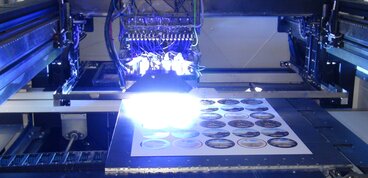
Why our digital printing machines are unbeatable in industrial digital printing!
Jun 30, 2023
Read article
Combined expertise in a dynamic duo
Aug 16, 2023
Read article


